If you’re thinking about refinancing your mortgage, one of the first questions you might ask is: What exactly are refinancing closing costs — and what am I paying for?
Refinancing isn’t free. Most homeowners pay 2% to 5% of their loan amount in closing costs, depending on the lender and loan program. But many borrowers are surprised to learn how many line items appear on their Loan Estimate — and which fees can be negotiated, reduced, or avoided.
This guide breaks down refinance fees, shows you what’s required vs. optional, and helps you understand your true cost so you can make
Key Takeaways
✅ Refinance closing costs typically equal 2%–5% of your loan amount
✅ Biggest fees include lender fees, title insurance, appraisal, and optional points
✅ Some charges (like title insurance) vary by state, while others are standard
✅ You can often reduce fees with credits, waivers, or lender competition
What Are Refinancing Closing Costs?
Refinancing closing costs are the fees you pay to replace your existing mortgage with a new one. These fees cover the lender’s work, third-party services, legal filings, and required insurance.
You may pay them:
Out of pocket at the closing
Rolled into the loan amount
Covered by lender credits (higher interest rate)
Refinance Fees Explained (Full Breakdown)
Refinance fees come in four major categories:
Lender fees
Third-party fees (appraisal, title, etc.)
Government fees
Prepaid items (escrow, interest)
Let’s go through each one in detail.
1. Lender Fees
These are charged directly by the lender handling your refinance. Each lender has its own fees, but here are the most common charges.
🔹 Origination Fee (1%-2% of loan amount)
Covers the lender’s cost to issue your loan. Some lenders charge 0%–1%, while others bundle costs into rate pricing.
🔹 Underwriting Fee ($400–$1,200)
Covers the lender’s review of income, assets, credit, and property.
🔹 Processing/Admin Fees ($300–$900)
Covers administrative work: documentation, file preparation, disclosures.
🔹 Discount Points (Optional: 0%–3% of loan amount)
Discount points buy down your interest rate.
1 point = 1% of the loan amount
Can cost thousands
May be a requirement to get a lender’s advertised rates
💡 Pro Tip: Many “low-rate” offers require you to pay points. Always check Box A on your Loan Estimate so you know what you’re getting.
2. Third-Party Fees
These fees are charged by outside companies hired during your refinance.
🔹 Appraisal Fee ($450–$900)
Determines home value and loan-to-value (LTV). Some borrowers qualify for appraisal waivers, which eliminate this cost.
🔹 Title Search & Title Insurance ($900–$3,500)
Protects the lender by ensuring the property’s title is clear. Costs vary widely by state and loan amount.
🔹 Settlement/Escrow Fee ($500–$1,500)
Charged by the closing or escrow company. Covers preparing and signing all documents.
🔹 Credit Report Fee ($25–$75)
Standard fee for pulling your credit to determine your eligibility for the loan.
🔹 Flood Certification ($10–$30)
Verifies whether your home is in a flood zone and requires flood insurance.
🔹 Notary Fees ($10–$200)
Covers final document signing in front of a notary public.
3. Government & Recording Fees
These fees go to your local or state government.
🔹 Recording Fees ($50–$200)
The county fee for recording the new mortgage and releasing the old one.
🔹 Mortgage Taxes / Transfer Taxes (0%–2%+)
Some states charge mortgage taxes, which can add hundreds or thousands of dollars to your closing costs.
4. Prepaid Items (Not Actually “Fees”)
Prepaid items affect cash-to-close but aren’t the true costs of refinancing.
🔹 Prepaid Interest ($100–$1,000)
Covers interest from the day you close to the end of the month.
🔹 Escrow Deposits ($500–$4,000+)
Funds your escrow account for:
Property taxes
Homeowners insurance
Your new lender may require 2–3 months of reserves.
💡 These are costs you pay whether you refinance or not — they’re just restructured during the process.
Typical Total Refinance Costs by Loan Amount
Loan Amount | Typical Cost Range |
$200,000 | $4,000–$10,000 |
$300,000 | $6,000–$12,000 |
$400,000 | $8,000–$14,000 |
$500,000 | $10,000–$18,000 |
$750,000 | $15,000–$25,000 |
$1,000,000 | $20,000–$40,000 |
Larger loans = higher title fees, lender fees, and optional points.
Which Refinance Fees Are Negotiable?
✔️ Lender fees
This is often the biggest area of savings. Some lenders offer $0 lender fees, but watch the rate, as it may increase to cover the cost of the lender credit.
✔️ Title insurance (reissue rate)
If you purchased your home recently, you may qualify for a discount.
✔️ Discount points
Always optional — consider paying them only if the break-even makes sense.
Example:
If refinancing costs $8,000 and saves you $250/month, your break-even point is 32 months.
If you plan to move before then, the refinance may not make financial sense.
✔️ Appraisal fee
Some lenders and loan programs allow an appraisal waiver, especially if you have strong credit or a large amount of equity in the home.
Which Fees Are NOT Negotiable?
❌ Recording fees
These fees are set by your county.
❌ Mortgage taxes
These fees are set by your state.
❌ Hazard insurance & property taxes
Your county and chosen insurance company set the fees, respectively.
Can You Refinance With No Closing Costs?
Yes, it may be possible through lender credits.
Lender credits:
Reduce or eliminate upfront fees
Slightly increase your interest rate
Best for:
Short-term homeowners
Cash-constrained borrowers
People focusing on upfront savings
Are Refinance Closing Costs Worth It?
They can be, if:
✔️ Your rate drops 0.5%–1%+
✔️ You can remove PMI
✔️ You plan to stay 2–3+ years or past your break-even point
✔️ Total interest savings exceed closing costs
Many refinances save tens of thousands in long-term interest.
How to Estimate Your Closing Costs (Step-by-Step)
Step 1: Get a Loan Estimate
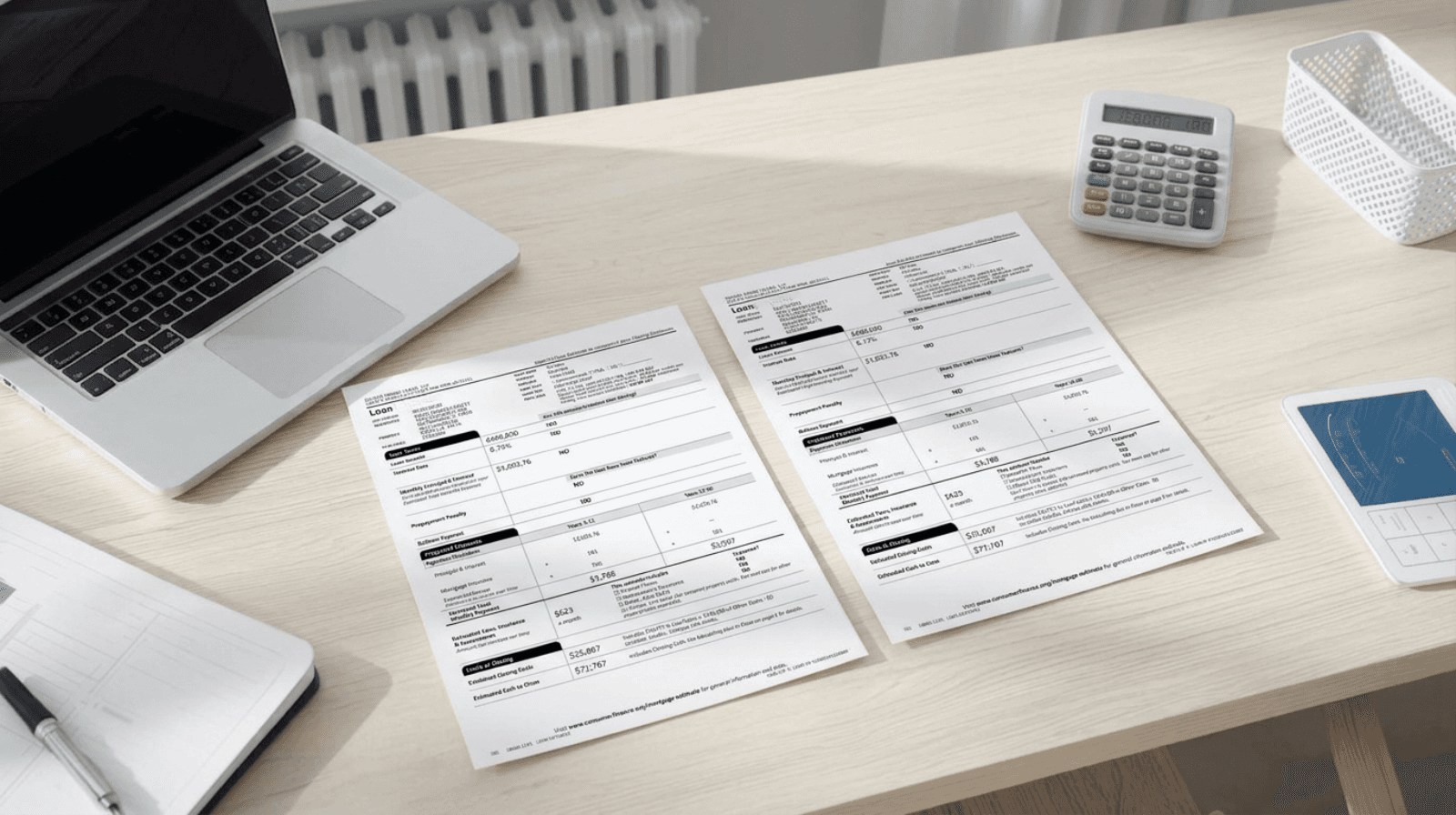
Each time you apply for a loan, the lender must issue a Loan Estimate, which includes all fees in Boxes A–J.
Compare APR in addition to the interest rate. Since APR includes many of these fees, but not all third-party costs, it should be used alongside total closing costs when comparing loans.
Step 2: Add up lender fees + title fees + appraisal
This is your true refinance cost.
Step 3: Identify everything optional
Make sure you don’t pay anything that’s unnecessary, including discount points. Two lenders can offer the same borrower completely different offers, so it’s important to shop around to make sure you get the most competitive deal.
Step 4: Shop offers using Fincast
You can shop your loan manually or use a platform like Fincast to automate the process and receive as many competitive quotes as possible.
If you already have a Loan Estimate, you can check it in minutes.
How Fincast Helps You Avoid Overpaying on Closing Costs
Two lenders can quote the same borrower, and be $5,000–$10,000 apart in total cost.
Fincast helps you see what your loan actually costs—and whether you’re overpaying. Instead of calling multiple lenders or guessing which fees matter, Fincast standardizes your Loan Estimates so you can look at total cost, fees, and rates side by side.
Here’s how:
1️⃣ Upload your Loan Estimate safely
2️⃣ Fincast helps break down your fees, APR, points, PMI, and closing costs
3️⃣ Vetted lenders may send you competitive quotes
4️⃣ You choose the best deal — no extra credit pulls and no unwanted calls
Even small savings in costs or points can save you thousands. Lender fees and pricing can vary by thousands—even for the same borrower.
FAQs: Refinance Closing Costs
1. What are refinance closing costs?
Fees paid to replace your existing mortgage with a new one.
2. How much are closing costs?
On average, they are 2%–5% of the loan amount, but they vary by lender and loan program.
3. Are closing costs negotiable?
Yes — especially lender fees and title fees. You can either negotiate with your current lender or shop around to ensure you have a competitive deal.
4. Can I roll closing costs into the loan?
Many lenders allow rolled-in closing costs, but make sure it makes sense to do so. Look at the total cost of the loan over time to ensure it makes sense.
5. Are discount points required?
No — points are optional. They raise the total cost, but may save you money over the loan term if you plan to stay long-term.
6. Can I refinance with no closing costs?
It may be possible if your lender offers a “no closing cost loan,” which means you’ll pay a slightly higher rate in exchange for no closing costs.
Bottom Line
Refinancing typically costs 2%–5% of the loan amount, though costs can be lower if you receive lender credits or skip optional fees like discount points. The biggest cost drivers—lender fees, title services, and points—can vary widely.
The goal isn’t just to lower upfront costs, but to choose the loan with the lowest total cost over time.
👉Many borrowers may overpay if they don’t look at multiple offers. Upload your Loan Estimate to Fincast and instantly see if you’re overpaying—and whether another lender has a more competitive offer. No impact to your credit score.
Rates, costs, and qualification requirements vary by borrower, lender, and market conditions. This is not a loan offer.
Disclaimer: Nothing in this content should be considered financial advice. The examples and data shared are for general information only and may not reflect your personal situation. We do not guarantee the accuracy or completeness of the information provided. Always do your own research and speak with a qualified financial advisor before making any financial decisions.
Ready to Save On Your New Mortgage?