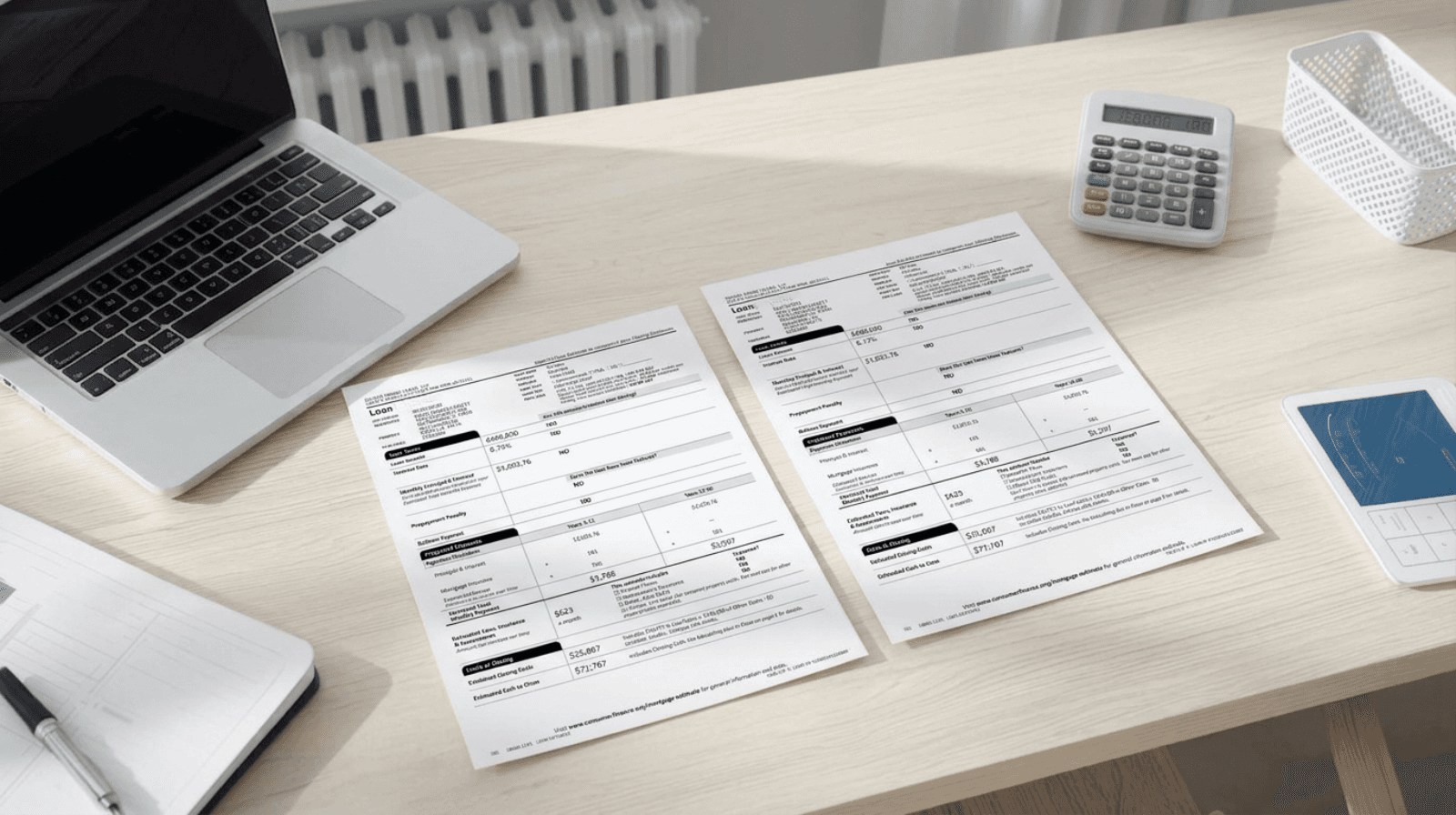

If you’re considering refinancing a $500,000 mortgage, your first question is likely: How much will the closing costs be?
Most refinance closing costs fall between 2% and 5% of the loan amount. For a $500K mortgage, that means refinancing typically costs $10,000 to $25,000. Your actual cost depends on your lender, your state, your credit profile, your loan type, and whether you pay discount points.
This guide breaks down each cost, shows typical price ranges, and explains how to lower your total expenses — so you can confidently decide whether refinancing your $500K loan is worth it. On a loan this size, even small differences in fees or rates can cost—or save—you thousands.
Key Takeaways
✅ Most $500k refinances cost $10,000–$25,000
✅ Discount points and state mortgage taxes can add thousands
✅ You may be able to roll costs into the loan
✅ Some lenders charge little to no origination fees, while others charge $4,000+
Rates, costs, and savings vary by borrower and market conditions.
Total Cost to Refinance a $500K Mortgage
Here’s a clear breakdown of common refinance expenses, which vary by location and loan program.
Typical Refinance Costs — $500K Loan
Cost Category | Typical Range |
Lender Fees | $1,800–$4,500 |
Appraisal | $450–$700 |
Title Insurance & Settlement | $1,800–$3,800 |
Credit Report | $25–$75 |
Recording Fees | $50–$200 |
Discount Points (Optional) | $0–$10,000+ |
State/County Mortgage Taxes | Varies (0%–2%+) |
Total Estimated Cost | $10,000–$25,000 |
Always compare APR—not just the interest rate—since it reflects the true cost of fees and points.
Cost Breakdown: What You're Paying For
Let’s break down each refinance cost so you understand where your money goes.
1. Lender Fees ($1,800–$4,500)
These typically include:
Origination
Underwriting
Processing
Admin fees
Some lenders charge minimal fees, while others charge higher fees.
2. Appraisal Fee ($450–$700)
Confirming your home’s value helps determine:
Loan-to-value ratio (LTV)
PMI eligibility
Refinance pricing
Strong borrowers may qualify for appraisal waivers.
3. Title Insurance & Settlement ($1,800–$3,800)
Covers:
Title search
Lender’s title insurance
Closing/escrow services
Notary fees
Title fees are often higher on larger loan amounts.
4. Credit Report ($25–$75)
A standard fee most lenders charge to determine your eligibility.
5. Recording Fees ($50–$200)
Charged by your county to record your new mortgage documents.
6. Prepaid Costs ($600–$4,000)
These aren’t actual “fees” but include:
Prepaid interest
Escrow setup for taxes and insurance
They affect cash-to-close, not the true refinance cost. They are required at closing, but not lender fees.
7. Discount Points (Optional: $0–$10,000+)
One discount point = 1% of the loan amount.
For a $500,000 loan:
1 point = $5,000
2 points = $10,000
Points lower your rate but can significantly raise your upfront cost.
Total Cost Scenarios for Refinancing a $500K Mortgage
Here are three realistic examples. These are for illustrative purposes only and do not constitute a loan offer.
Scenario 1: Low-Cost Refinance (~$10,000 Total)
No points
Low lender fees
Appraisal waived
📉 Estimated Total: ~$10,000
Scenario 2: Typical Refinance ($12,000–$16,000)
Standard lender fees
Full title and escrow fees
Appraisal required
No discount points
📉 Estimated Total: $12,000–$16,000
Scenario 3: High-Cost Refinance ($18,000–$25,000+)
1–2 discount points
High-fee lender
📉 Estimated Total: $18,000–$25,000
💡 Pro tip: Wondering if your quote is high? Upload your Loan Estimate to Fincast and see your options.
How to Lower Your Refinance Costs on a $500K Mortgage
✔️ Avoid discount points
Look for a lender that won’t charge discount points to get the rate you need.
✔️ Request multiple Loan Estimates
Each time you apply for a loan, the lender must issue a Loan Estimate within three business days. You can do this manually, or use Fincast to get multiple offers from a single Loan Estimate.
✔️ Ask about appraisal waivers
If you are a low-risk borrower and have adequate equity in the home, some lenders may waive the appraisal.
✔️ Use lender credits
Lender credits reduce your upfront cost in exchange for a slightly higher rate.
✔️ Ask the title company for reissue rates
If you bought your home recently, you may qualify for reduced fees.
✔️ Compare APR, not just rate
APR includes fees — a better indicator of the true cost.
💡 Pro Tip: Some lenders advertise ultra-low rates only if you pay 1–2 points. Always check Box A of the Loan Estimate.
Can You Roll Refinance Costs Into a $500K Loan?
Many lenders allow you to roll refinance costs into the loan, but be sure to look at the total cost of the loan over the term to see if it’s the right move.
Example:
Rolling $12,000 into a $500k refinance → $512,000 new loan amount
Pros:
No upfront cash
Lower barrier to refinancing
Cons:
Slightly higher monthly payment
Higher lifetime interest
Is Refinancing a $500K Mortgage Worth the Cost?
It depends on:
✔️ Your rate drop
Savings are often in the $100–$300+ range per month, with a 0.5%-1% rate drop, depending on loan terms.
✔️ PMI removal
Eliminating PMI can save hundreds per month, depending on your PMI rate.
✔️ How long do you plan to stay
If your break-even period is short, staying in the home for 2-3 years may allow you to reap the savings after paying off the costs.
Break-even formula:
Divide your total closing costs by your monthly savings to estimate how long it takes to recover the cost of refinancing.
✔️ Total interest savings
A 1% rate drop often saves thousands and sometimes tens of thousands of dollars in interest.
How to Estimate Your Refinance Costs (Step-by-Step)
Step 1: Request a Loan Estimate
When you apply for a loan, the lender must issue a Loan Estimate within three business days. This disclosure breaks down your costs so you can compare loans on an apples-to-apples basis.
Step 2: Add lender fees, title fees, appraisal fees, and recording fees
This is your true refinance cost.
Step 3: Look for discount points
You’ll see discount points listed in Box A.
Step 4: Add state taxes (if applicable)
Step 5: Upload your estimate to Fincast
Fincast allows you to see various offers from lenders to determine which makes the most financial sense.
How Fincast Helps You Lower Refinance Costs
Fees can vary significantly between lenders, and some costs may not be obvious at first glance.
Fincast helps you see what your loan actually costs—and whether it’s competitive.
Here’s how:
1️⃣ Upload your Loan Estimate safely
2️⃣ Fincast breaks down your fees, APR, points, PMI, and closing costs
3️⃣ Vetted lenders may send you competitive quotes
4️⃣ You choose the best deal — no extra credit pulls and no unwanted calls
Even small savings in costs or points can save you thousands. Lender fees and pricing can vary by thousands—even for the same borrower.
FAQs: Refinance Costs for a $500K Mortgage
1. How much does it cost to refinance a $500k mortgage?
Typically $10,000–$18,000 on average, depending on fees, points, and taxes.
2. Are refinance closing costs negotiable?
Yes — lender fees and some title fees can often be reduced if you shop around and negotiate with lenders.
3. Can I refinance with no closing costs?
Some lenders offer no-closing-cost programs, but at a higher rate. Be sure you see the big picture before deciding.
4. Are discount points required to refinance?
No — points are optional. They raise the total cost, but may save you money over the loan term if you plan to stay long-term.
5. Can I roll refinance costs into my loan?
Many lenders allow rolled-in closing costs, but make sure it makes sense to do so. Look at the total cost of the loan over time to ensure it makes sense.
6. Will refinancing save me money?
It depends on the interest rate, closing costs, and your break-even point.
Bottom Line
Refinancing a $500,000 mortgage typically costs $10,000 to $25,000, depending on your lender, location, and whether you pay discount points. The biggest cost drivers—lender fees, title services, and points—can vary widely.
The goal isn’t just to lower upfront costs, but to choose the loan with the lowest total cost over time.
👉Most borrowers overpay because they don’t compare. Upload your Loan Estimate to Fincast and see if you could save thousands in fees or points.
Disclaimer: Nothing in this content should be considered financial advice. The examples and data shared are for general information only and may not reflect your personal situation. We do not guarantee the accuracy or completeness of the information provided. Always do your own research and speak with a qualified financial advisor before making any financial decisions.
Ready to Save On Your New Mortgage?