If your credit score feels like it's holding your dreams hostage — you're not alone.
Millions of hopeful homebuyers sit on the sidelines every year, believing bad credit is a life sentence. But here's the truth: credit isn't permanent. It's a system — and systems can be fixed.
This guide walks you through a proven, legal, and realistic way to rebuild your credit. Whether you're trying to qualify for your first mortgage, refinance for a better rate, or stop lenders from rejecting you, you'll learn how credit works and how to take control.
Important reality check: Credit repair takes time. Anyone promising 200+ point increases in 90 days is either lying or their clients had mostly fraudulent accounts. Real credit rebuilding typically takes 12-36 months, costs nothing, and requires patience and discipline.
Why Your Credit Score Matters So Much in Homebuying
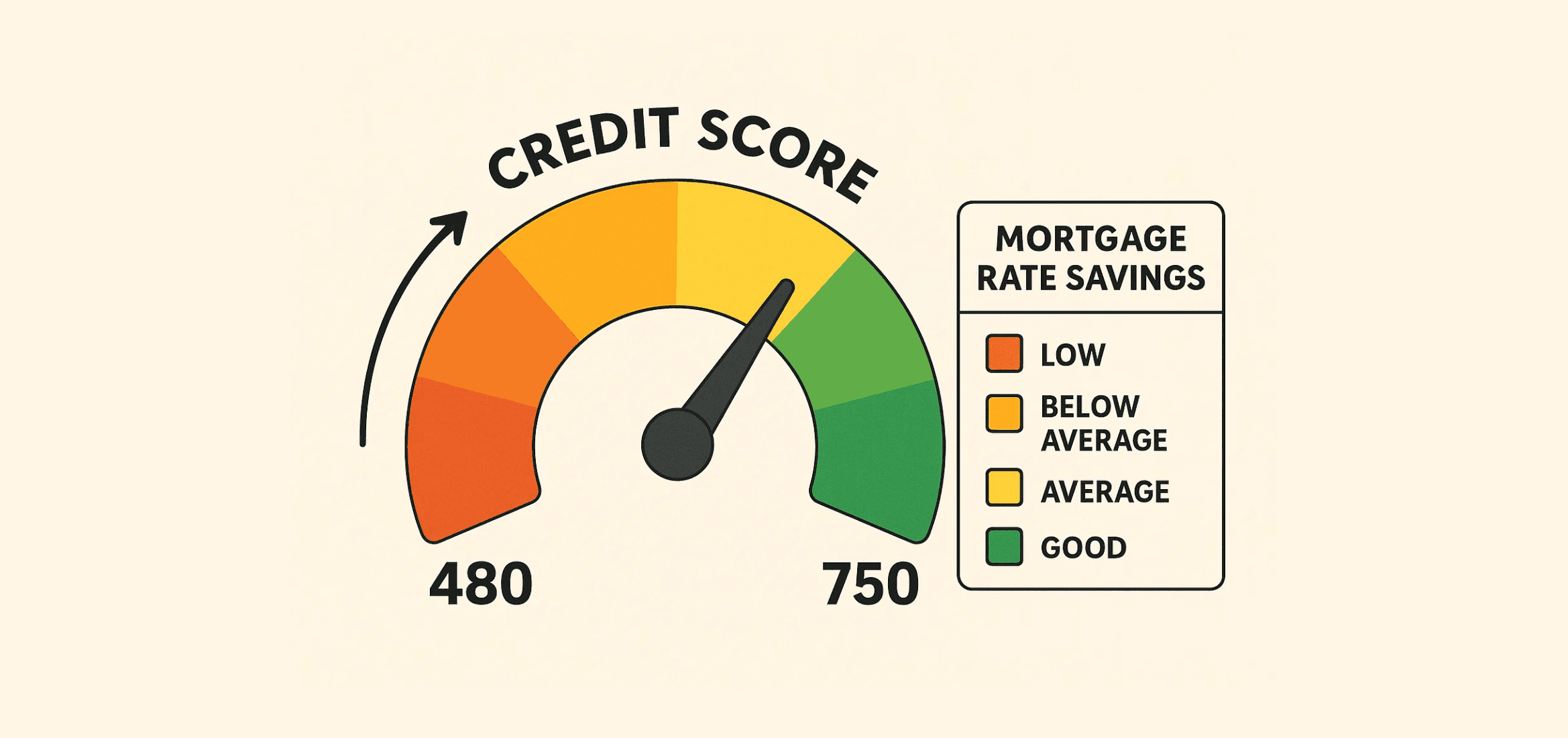
Your credit score doesn't just affect whether you're approved for a loan — it changes the price of everything you borrow.
Let's put real numbers on it based on current 2025 rates:
Credit Score | Typical 30-Year Fixed Mortgage Rate | Monthly Payment on $320K Loan | Total Interest Paid |
760+ | 6.83% | $2,088 | ~$432,000 |
680-699 | 7.24% | $2,178 | ~$464,000 |
640-659 | 7.65% | $2,272 | ~$498,000 |
That's $66,000 more in interest over 30 years, comparing a 760+ score to a 640-659 score — for the same house, same borrower, just different credit scores.
So yes, those credit score points can change your financial life.
Step 1: Understand the Game (and Your Rights)
The credit system isn't built for consumers — it's built for lenders. But you have legal protections under the Fair Credit Reporting Act (FCRA).
What the law actually says: Credit bureaus (Experian, Equifax, and TransUnion) must investigate disputes within 30 days. If they can't verify information as accurate, they must delete it. However, they successfully verify most disputed items because creditors have documentation.
Reality check: According to a 2006 Federal Reserve study, only about 20-25% of disputed items are actually deleted. The rest are verified as accurate or modified. The credit repair industry often claims 70% success rates, but no government agency or credit bureau confirms this figure.
Your job is to dispute actual errors — not to flood bureaus with frivolous disputes hoping creditors won't respond.
Step 2: The Credit Audit (Week 1)
Go to annualcreditreport.com — the only truly free, government-authorized source for all three reports.
Make a list of:
Every late payment (verify it's accurate)
Every collection (is it yours? correct amount?)
Every charge-off (do you recognize it?)
Every hard inquiry (did you authorize it?)
Personal information errors (wrong address, misspelled name, etc.)
Screenshot everything for your records.
Critical distinction: Only dispute items that are actually wrong or that you don't recognize. Disputing accurate negative information won't work and wastes everyone's time.
Step 3: Dispute What's Actually Wrong (Weeks 2-4)
For each genuinely inaccurate item, file a dispute online or via certified mail, asking the credit bureau to investigate. You can request:
Verification that the information is accurate
Correction of incorrect dates, amounts, or status
Removal if the item is not yours or can't be verified
What to expect:
Bureaus have 30-45 days to investigate
About 20-25% of disputes result in deletion
Most items are verified and remain on your report
Some items may be updated or corrected
✅ Realistic result: If you have actual errors, they'll likely be removed. If items are accurate, they'll stay for their full reporting period (typically 7 years for most negative items).
Step 4: Request Goodwill Adjustments (Weeks 2-4)
If you have legitimate late payments from a creditor you have a good history with (say, you missed one payment during a medical emergency), you can ask for mercy.
Send a short, polite letter:
"I've been a customer for [X] years and have maintained excellent payment history except for [specific incident]. Due to [legitimate hardship: medical emergency, job loss, natural disaster], I experienced temporary difficulty. I've since recovered and returned to on-time payments. Would you consider removing this late payment as a goodwill gesture?"
Reality check: Most creditors refuse these requests because they have legal and contractual obligations to report accurate information. Major banks like Chase and Bank of America explicitly don't grant goodwill adjustments. Smaller creditors and credit unions sometimes do, especially for longtime customers with one isolated incident.
Success rate: Unknown — no credible statistics exist. Try once or twice politely, but don't expect success. Consider it a bonus if it works.
Step 5: Understand Pay-for-Delete (Weeks 2-4)
For collections, you can sometimes negotiate deletion in exchange for payment, but this strategy has significant limitations.
The reality:
Most major creditors and reputable debt collectors refuse due to credit bureau contracts
Small third-party collection agencies may agree (perhaps 30-50% of the time)
You must get any agreement in writing before paying
Newer FICO models (FICO 9, 10) ignore paid collections anyway
If you try this approach:
"I'm willing to pay this debt in full if you agree to request deletion from all three credit bureaus. Please provide this agreement in writing before I submit payment."
Important: Never pay until you have written confirmation. Many collectors will take your money and refuse to delete.
Alternative approach: Simply pay or settle the debt, knowing that its impact will fade over time even if it stays on your report. The most recent version of FICO scores (FICO 9 and later) ignore paid collections entirely.
Step 6: Build Positive Credit History (Months 2-12)
Negative marks hurt, but a lack of positive history hurts even more. Start rebuilding immediately with:
Secured Credit Card ($200-500 deposit)
Your deposit becomes your credit limit
Use it for small purchases monthly
Pay in full every month — this is critical
Typically converts to an unsecured card after 6-12 months
Credit Builder Loan ($500-1,000)
Banks or services like Self offer these
You make payments into a savings account
Get the money back at the end
Builds payment history
Become an Authorized User
Find a family member with excellent credit (750+, 10+ year history, low utilization)
Their positive history can help your score
Important: Modern FICO versions have reduced this impact, so it's not the dramatic "50-100 point instant boost" some claim
Realistic expectation: 10-40 point improvement, depending on your credit profile
What to expect:
First positive accounts report in 30-60 days
Score improvement is gradual, not immediate
FICO states you'll notice "small changes within three to six months"
Meaningful improvement takes 6-12 months of consistent positive behavior
Step 7: Optimize Utilization (Ongoing)
Credit utilization — the percentage of your available credit you're using — is 30% of your FICO score. This is one of the fastest ways to improve your score because it updates when your card issuer reports your balance.
Optimal utilization: 1-9%
The strategy:
Keep total utilization under 10%
Keep per-card utilization under 10%
1% is ideal (using cards but keeping balances very low)
0% is actually worse than 1% because you need to show some usage
Example:
$1,000 credit limit → Spend $500 → Pay $490 before the statement closes → Your statement shows $10 balance = 1% utilization = perfect for your score
Realistic expectations:
Moving from high utilization (50%+) to low (<10%): 20-40 point improvement typically
You'll see the change within 30-45 days after your new balance is reported
The "30-50 point jump", some claim, is possible only in extreme cases (moving from 70%+ to <10%)
Step 8: Handle Hard Inquiries Correctly (Ongoing)
Hard inquiries (credit pulls) stay on your report for 2 years but only affect your score for about 12 months. Each inquiry typically reduces your score by less than 5 points, according to FICO.
You can dispute inquiries that:
You don't recognize (actual fraud)
Were made without your permission
Are duplicates of the same application
Do NOT dispute legitimate inquiries by claiming you didn't authorize them when you did. This could constitute making false statements to federal agencies.
Realistic expectations:
Fraudulent inquiry removal: Yes, these should be removed
Legitimate inquiry removal: Won't happen
Score impact per inquiry: Less than 5 points for most people
Rate shopping window: Multiple inquiries for mortgages or auto loans within 14-45 days count as ONE inquiry
Real-Life Results (and What's Realistic)
Realistic improvement scenarios:
Scenario 1: Starting at 480 with multiple errors
Remove 2-3 collections that weren't yours: +40-80 points
Remove incorrect late payments: +20-40 points
Add secured card and make on-time payments: +20-30 points over 6 months
Improve utilization: +20-30 points
Timeline: 6-12 months to reach 580-620
Timeline: 18-24 months to reach 680-720
Scenario 2: Starting at 480 with mostly accurate negative history
Pay down credit card debt (improve utilization): +20-40 points
Add secured card, 12 months perfect payments: +30-50 points
Negative marks gradually age and lose impact: +40-80 points
Timeline: 12-18 months to reach 560-600
Timeline: 24-36 months to reach 680-720
Scenario 3: Starting at 620 with one major negative
Remove error or successfully negotiate deletion: +40-60 points
Continue positive payment history: +20-40 points
Timeline: 6-12 months to reach 700+
FICO's official guidance: "There is no quick way to fix a credit score. Quick-fix efforts are the most likely to backfire. Working on your FICO Scores is typically a gradual process that requires time, patience, and discipline."
Anyone claiming 200+ point increases in 90 days is either lying or their clients had primarily fraudulent accounts that were removed.
The Maintenance Plan: Reaching and Keeping 750+
Once your score improves, maintain it by:
Payment History (35% of score) — Most Important
Set ALL bills to autopay
Never miss a payment — even one can drop your score 60-110 points
If you miss one, catch up immediately and stay current
Credit Utilization (30% of score) — Quick Impact
Keep utilization under 10% (1-9% is optimal)
Pay balances before the statement closes if needed
Request credit limit increases (but don't increase spending)
Length of Credit History (15% of score) — Passive Growth
Keep old cards open, even if unused
Use them occasionally (once every 3-6 months) to keep them active
Don't close your oldest accounts
Credit Mix (10% of score) — Minor Factor
Ideal: both revolving credit (cards) and installment loans (auto, mortgage)
Don't take on debt just for mix — only when needed
New Credit (10% of score) — Be Strategic
Limit new applications to when you actually need credit
Rate shop for mortgages/auto loans within a 14-45 day window
Space out credit card applications (6+ months between)
Think of it as credit fitness. You don't need perfection — just steady discipline.
The Big Picture: Credit Isn't Forever — But It Does Take Time
Bad credit isn't a moral failure. It's a solvable problem. But anyone promising quick fixes in 90 days is either scamming you or promoting illegal tactics.
The truth:
Significant credit improvement takes 12-36 months, not 90 days
You can do everything yourself for free
Negative marks fade over time — most disappear after 7 years
Consistent positive behavior is the only proven strategy
By following this realistic plan:
Dispute actual errors (not accurate negative information)
Build a positive payment history consistently
Optimize your utilization
Exercise patience and discipline
You can rebuild from a 480 to 680-720+ within 18-36 months and eventually reach 750+ as negative marks age off your report.
When you're ready to shop for your mortgage, compare offers from multiple lenders to ensure you're getting the best rate for your improved credit score. Tools like Fincast can help you compare true costs, not just teaser rates — so you see who’s really giving you the best deal.
FAQ
1. Is credit repair legal?
Yes — when you dispute genuinely inaccurate information. No, when you dispute accurate information, hoping creditors won't verify it, or when you make false claims. The FTC prosecutes credit repair scams that charge fees for services you can do yourself for free or that promise to remove accurate information.
2. Can I do this myself?
Absolutely. The FTC states clearly: "Anything a credit repair company can do legally, you can do yourself at little or no cost." Don't pay $500-3,000 for services you can dofor free.
3. How soon can I buy a home after fixing my credit?
You can apply for preapproval as soon as your score meets lender minimums (typically 580-620 for FHA, 620-640 for conventional). However, lenders want to see:
12-24 months of on-time payments after major credit problems
Stable employment and income
Sufficient down payment and reserves
4. What's the best credit score for a mortgage?
A score above 740 typically gets the best rates. FHA loans can approve borrowers as low as 580 (500 with 10% down), but you'll pay higher rates and fees. Every 20-40 point improvement can save you thousands in interest.
5. What if I have accurate negative information?
Focus on building a positive history to outweigh it. Negative marks lose impact over time:
Late payments: Less impactful after 12-24 months, removed after 7 years
Collections: Less impactful after 12-24 months, removed after 7 years
Charge-offs: Less impactful after 24 months, removed after 7 years
Bankruptcy: Less impactful after 2-3 years, removed after 7-10 years
You can't remove accurate information, but you can minimize its impact by adding positive accounts and maintaining a perfect payment history.
6. Should I pay for credit repair services?
No. The FTC warns that most credit repair companies charge high fees for services that either don't work or that you can do yourself for free. Red flags include:
Promises to remove accurate negative information
Guarantees of specific results
Charges fees before services are performed
Suggests disputing accurate information
Tells you to lie on applications or disputes
Bottom line: Your credit score isn't your worth — it's a snapshot of your credit behavior.
Start rebuilding today with realistic expectations. While it takes time, the financial benefits are substantial. That improved credit score will save you tens of thousands in interest and open doors to better financial opportunities.
The truth: It's not a 90-day fix. It's an 18-36 month journey. But unlike the quick-fix promises, this approach actually works.
Disclaimer: Nothing in this content should be considered financial advice. The examples and data shared are for general information only and may not reflect your personal situation. We do not guarantee the accuracy or completeness of the information provided. Always do your own research and speak with a qualified financial advisor before making any financial decisions.
Ready to Save On Your New Mortgage?