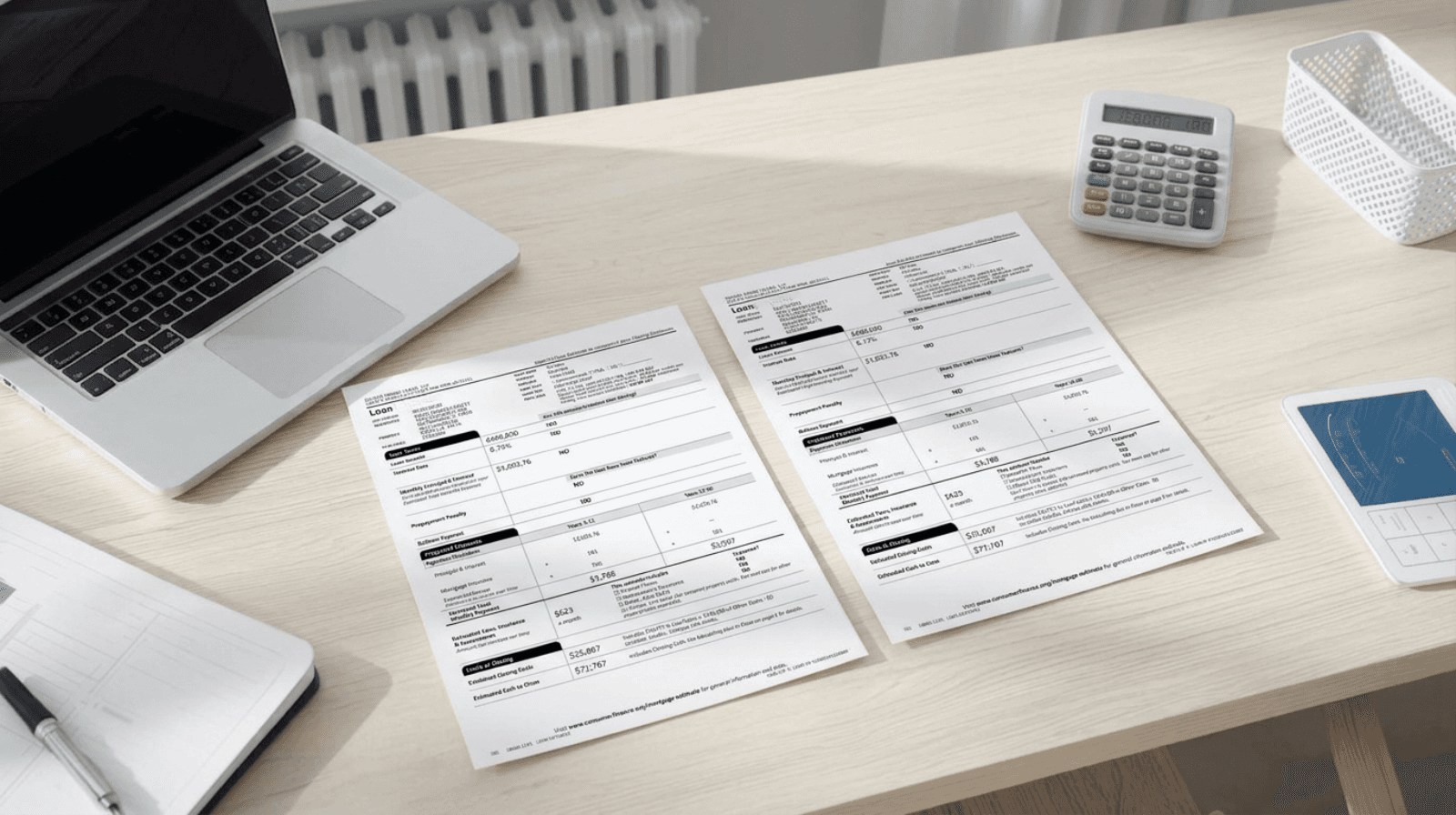

When homeowners think about refinancing, they’re usually talking about rate-and-term refinancing — the most common type of refinance. It allows you to replace your existing mortgage with a new one that has a better interest rate, a different loan term, or both. Unlike a cash-out refinance, you’re not borrowing additional money beyond what’s needed to pay off your current loan.
Short answer:
Rate-and-term refinancing is used to lower your interest rate, reduce your monthly payment, shorten your loan term, switch loan types (like FHA → conventional), or remove PMI. It’s the most flexible and widely available refinance option — often requiring little equity and offering the best pricing.
This guide explains exactly how rate-and-term refinancing works, why homeowners choose it, eligibility requirements, savings examples, and how to benchmark your Loan Estimate to ensure your refinance is actually a good deal.
Key Takeaways
Rate-and-term refinancing replaces your existing mortgage with a new loan — without taking additional cash out
Its main purpose is to lower your rate, adjust your loan term, or remove PMI
It typically requires less equity than cash-out refinancing
It often offers the best rates and lowest fees among all refinance types
You can use it to switch loan types (e.g., FHA to conventional) to eliminate mortgage insurance
💡Pro tip: The biggest savings often come from choosing the right lender, not just from the refinance itself. Upload your Loan Estimate to Fincast and let vetted lenders compete to beat your refinance offer.
What Is Rate-and-Term Refinancing?
A rate-and-term refinance replaces your current mortgage with a new one that changes:
Your interest rate
and/or
Your loan term
You are not taking cash out, and your new loan amount is generally only high enough to:
Pay off your existing mortgage
Cover closing costs
Roll in prepaid items (optional)
Because you’re not borrowing extra money, lenders treat these loans as lower risk, which may mean better pricing for borrowers.
💡Pro tip: Applying with multiple lenders can take a lot of time, but not shopping can leave money on the table. Upload your Loan Estimate to Fincast to get multiple offers without additional applications.
What Rate-and-Term Refinancing Can Do for You
Borrowers often use rate-and-term refinancing to reduce monthly payments or save money over the life of the loan.
1. Lower Your Interest Rate
This is the reason many homeowners refinance.
A lower rate can:
Reduce your monthly payment
Reduce your total interest paid
Shorten your break-even point
Even a small rate drop (0.25%–0.75%) can save thousands over the life of the loan.
💡 Pro Tip: Calculate your break-even point now — it will help you determine whether refinancing is worth it before you start the process.
2. Lower Your Monthly Payment
By lowering your rate or extending your loan term (e.g., from 25 to 30 years), rate-and-term refinancing may reduce your monthly payment.
3. Remove PMI
If your LTV is 80% or lower, you can remove private mortgage insurance — often saving hundreds per month.
This is one of the biggest financial wins from refinancing at the right time.
4. Switch Loan Types
Common scenarios include:
FHA → conventional to remove mortgage insurance (FHA loans require MIP for the life of the loan in most cases)
Adjustable-rate mortgage (ARM) → fixed to lock in stability
Conventional → FHA if you need more flexible underwriting
5. Change Your Loan Term
You may be able to refinance from a 30-year to a 15-year loan or even from a 15-year to a 30-year loan.
Switching to a 15-year loan may reduce total interest paid — often by six figures — even if your monthly payment increases. Whereas refinancing from a 15-year to a 30-year term may lower your monthly payment, but increase your total interest paid.
6. Remove or Add a Borrower
A rate-and-term refinance can help:
Remove a co-signer
Add a spouse
Adjust legal ownership
This is common after divorce, marriage, or estate planning changes.
How Rate-and-Term Refinancing Works
Every lender has a slightly different process, but here’s a general overview.
Step 1: Apply with a lender
Complete a loan application, and provide proof of income, assets, credit, and property information.
Step 2: Get a Loan Estimate (LE)
Within three business days of completing the application, your lender must issue a Loan Estimate. This document breaks down your rate, closing costs, and terms.
Step 3: Appraisal (if required)
If the lender and loan program require an appraisal, the lender will order it. They do this to confirm your Loan-to-Value ratio.
Step 4: Underwriting
During underwriting, the lender reviews your income, credit, and financials to determine they meet the program and lender requirements.
Step 5: Closing
At closing, you sign the loan documents, and your new rate takes effect.
Most refinances take 25–45 days, depending on the lender's processing speed, appraisal timelines, and how quickly you respond to requests.
How Much Equity You Need for a Rate-and-Term Refinance
Rate-and-term refinances are flexible, but requirements vary by lender and loan program. Here are some of the most common requirements:
Conventional Loans
Up to 95% LTV allowed
Best rates are often at 80% LTV or lower
FHA Loans
Up to 97.75% LTV for eligible rate-and-term refinances
FHA streamline may require no appraisal
VA Loans
No equity requirement for most streamline refinances (IRRRL)
Jumbo Loans
Usually requires 75–80% LTV or lower
The exact requirements vary not only by loan program but also by lender, as each lender can have different overlays (requirements) to protect their investment.
Rate-and-Term vs. Cash-Out Refinancing
Feature | Rate-and-Term | Cash-Out |
Takes cash out? | No | Yes |
Best rates? | ✔ Can be competitive | ❌ Higher pricing |
Equity needed | 3–20% | 20–25% after closing |
PMI removal | Possible | Possible, but rare |
Appraisal required | Usually | Most lenders require one |
Best for | Lowering the monthly payment, switching the loan type | Accessing cash |
Rate-and-term refinancing is cheaper, simpler, and more focused on improving your mortgage — not borrowing against equity.
How Much You Can Save: Real Examples
Example 1: Lowering Your Rate
Old rate: 7.00%
New rate: 6.25%
Loan amount: $400,000
Monthly savings: ~$205
Break-even: ~33 months (assuming $6,800 in closing costs)
Example 2: Removing PMI
Loan: $350,000
PMI: $210/month
Savings from PMI removal: $2,520 per year
Total refinance savings: Often $4,000–$7,000 per year
Example 3: Switching to a 15-Year Loan
Even if your payment increases, you may save $80,000–$150,000+ in lifetime interest.
When Rate-and-Term Refinancing May Make Sense
Choose a rate-and-term refinance when:
✔ Rates have dropped
✔ You have 20% equity and want to remove PMI
✔ You want to switch loan types
✔ You want to shorten your mortgage
✔ You want lower monthly payments
✔ Your credit score has improved
✔ You have an FHA loan and want to eliminate MIP
✔ You want to lock in a fixed rate
When It Might Not Be the Right Time
Consider waiting if:
Your break-even point is too long
You plan to move within 1–2 years
Your appraisal may come in low
Rates are expected to drop further
Your credit score is temporarily lower
Where Fincast Fits In
Rate-and-term refinances are popular — but lender pricing varies more than most borrowers realize. Two lenders offering the same interest rate may differ by thousands in fees or points.
Fincast helps you understand all your options so you can make confident choices. Once you have a Loan Estimate in hand, it’s the best time to compare, before you’re locked in.
How it works:
Upload your Loan Estimate
Fincast analyzes your pricing
Fincast shares your information anonymously with vetted lenders
You choose the best deal
FAQs: Rate-and-Term Refinancing
1. What’s the main purpose of rate-and-term refinancing?
Every borrower has a different reason for using a rate-and-term refinance, but they are often used to lower your rate, adjust your loan term, or remove PMI.
2. How much equity do I need?
Every lender differs, but some programs require as little as 3–5% equity and 20% equity for PMI removal.
3. Can I get cash back with a rate-and-term refinance?
Lenders typically allow only minimal incidental amounts (typically $500–$2,000). For large cash amounts, you must do a cash-out refinance.
4. Do I need an appraisal?
Often yes, but FHA and VA streamline refinances may waive it, as may certain lenders using automated underwriting programs.
5. How long does the process take?
Typically 25–45 days, but the actual time varies by lender and borrower response.
6. Does rate-and-term refinancing affect PMI?
Yes — if your LTV is 80% or lower, you may be eligible to remove PMI.
Bottom Line
Rate-and-term refinancing is the most effective way to lower your rate, reduce your payment, remove PMI, or switch loan types. It offers the best pricing, requires less equity than cash-out refinances, and can produce thousands in savings when timed correctly.
But lenders structure rates and fees differently, so comparing offers is essential.
👉 See if you’re overpaying in under two minutes. Upload your Loan Estimate to discover how much you could save before you sign anything. No spam. No credit pull. Just vetted lenders competing for your business.
This content is for educational purposes only. Rates, fees, and availability vary by lender and borrower profile.
Disclaimer: Nothing in this content should be considered financial advice. The examples and data shared are for general information only and may not reflect your personal situation. We do not guarantee the accuracy or completeness of the information provided. Always do your own research and speak with a qualified financial advisor before making any financial decisions.
Ready to Save On Your New Mortgage?