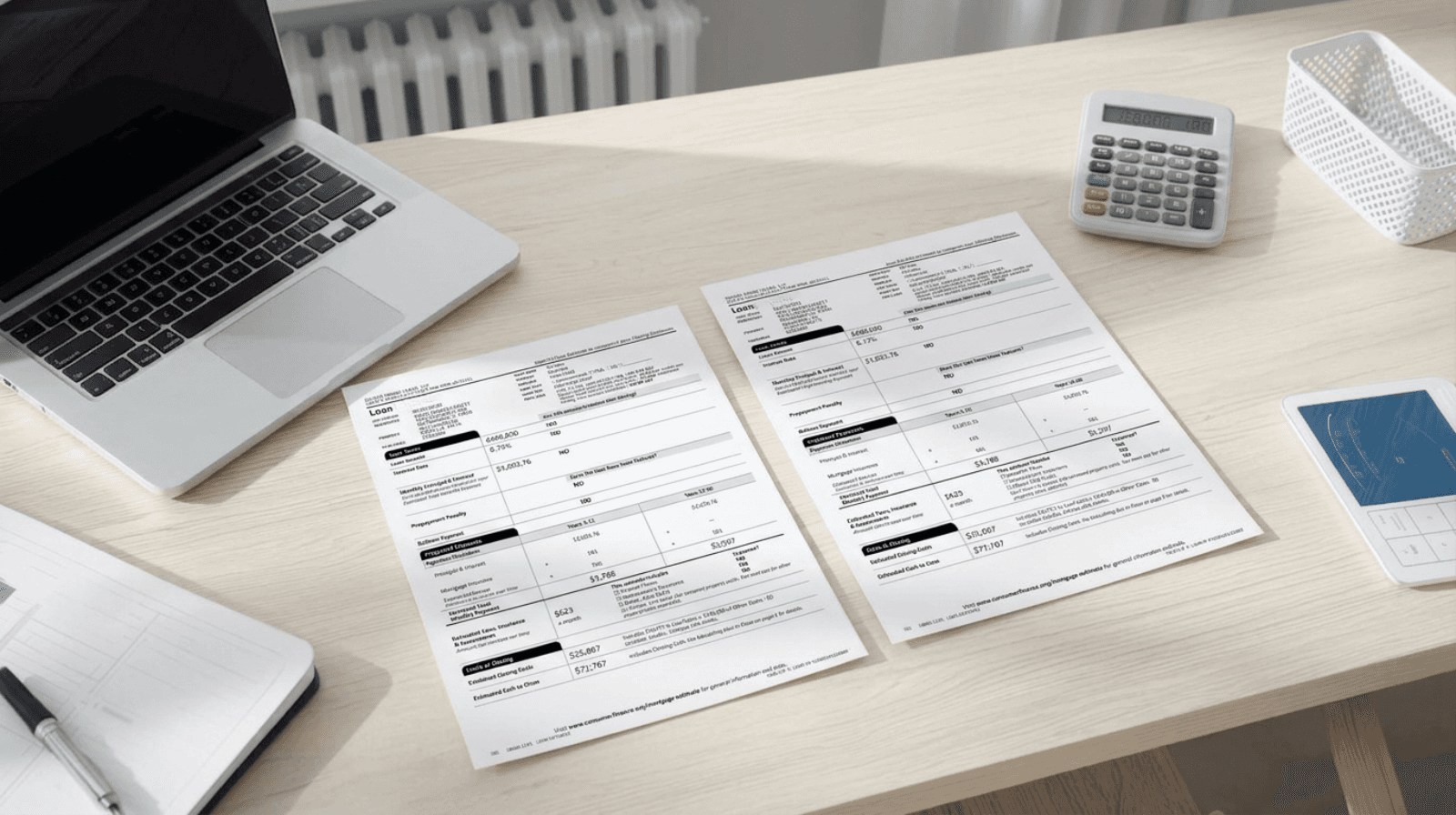

When comparing mortgage options, you may receive rate estimates from several lenders over the phone — and later, a Cost Worksheet via email.
At first glance, both outline your loan costs. But they’re not the same.
A phone quote is a quick, verbal estimate based on general information you provide over the phone. A Cost Worksheet is a detailed, written breakdown of estimated fees and payments — more specific, but still unofficial.
Understanding how they differ helps you compare lenders more accurately and avoid surprises down the road.
Key Takeaways
Phone Quote:
A brief, verbal rate and payment estimate based on self-reported details — helpful for early comparison, but not binding.
Cost Worksheet:
A written, lender-generated breakdown of estimated loan costs, third-party fees, and cash-to-close — more detailed, but still not an official disclosure.
Biggest Difference:
Phone Quote = verbal estimate.
Cost Worksheet = written breakdown.
💡 Pro Tip: After you choose a lender and complete the formal application, the lender must issue your official Loan Estimate. This is a legally binding document that outlines costs. Upload it to Fincast, and let vetted lenders compete to beat your deal, with no extra credit pulls or spam.
What Is a Phone Quote?
A phone quote is an informal rate estimate you receive during an early conversation with a lender or loan officer.
It’s quick and convenient — meant to give you a ballpark idea of what your interest rate and monthly payment may look like based on your credit, income, and down payment.
A phone quote is not verified or documented; it’s only useful for broad comparisons.
A phone quote typically includes:
Estimated interest rate and APR
Loan type and term
Approximate monthly payment
Basic assumptions (credit score, property type, down payment)
Rough estimate of closing costs
👉 Think of a phone quote as your verbal snapshot — a first impression, not the final picture.
What Is a Cost Worksheet?
A Cost Worksheet is a written estimate that your lender provides after discussing your loan and financial situation. Some lenders issue one after you’ve provided proof of income, assets, and your credit scores.
It’s not a federally required form, but it provides a clearer, line-by-line preview of your loan’s estimated costs and payments before receiving your official Loan Estimate.
A Cost Worksheet typically includes:
Loan amount, rate, and term assumptions
Estimated monthly payment
Itemized lender fees (origination, processing, underwriting)
Third-party fees (appraisal, title, escrow)
Prepaid items (taxes, insurance, interest)
Estimated total cash to close
👉 Think of a Cost Worksheet as your cost preview — a detailed estimate of what your mortgage may look like before you apply.
Phone Quote vs Cost Worksheet: Side-by-Side
Feature | Phone Quote | Cost Worksheet |
When You Get It | Early — during a phone call | After your initial conversation or inquiry |
Purpose | Quick verbal rate and payment estimate | Detailed written breakdown of fees and payments |
Verification | Based on self-reported info | Based on a semi-verified loan scenario |
Format | Verbal | Written, itemized document |
Regulation | Not regulated | Not federally required, but lender-standardized |
Best For | Early rate comparison | Reviewing estimated costs before applying |
How Should I Use Both When Buying a Home?
Each document plays a distinct role at a different point in the mortgage process — one for exploration and one for evaluation.
Step 1: Start With Phone Quotes
Contact several lenders to obtain quick rate and payment estimates. This helps you identify the competitive lenders.
Step 2: Request Cost Worksheets
From your top lenders, ask for written Cost Worksheets after providing verified information about your situation. Compare each lender’s itemized fees line by line.
Step 3: Apply for Your Loan
Once you’re ready, apply with your chosen lender. Within three business days, you’ll receive your official Loan Estimate, which standardizes all costs for clearer comparison. It’s also legally binding.
Step 4: Upload to Fincast
Upload your Loan Estimate to Fincast. The platform lets vetted lenders compete for your business by offering better rates, terms, and costs based on the information provided, and there’s no impact to your credit.
Step 5: Confirm Before You Lock
Compare your Cost Worksheet to your Loan Estimate to confirm accuracy before locking in your rate or proceeding with the loan.
Why Both Matter
Your phone quote helps you start the conversation.
Your Cost Worksheet outlines the numbers behind it.
Together, they help you move from guessing to comparing — ensuring you know exactly what to expect before applying for a loan.
Shop Real Offers Effortlessly Using Fincast
Before locking your loan, take a few minutes to verify your deal.
Upload your Loan Estimate to Fincast and let the platform instantly benchmark your offer against vetted lenders, revealing better rates or unnecessary fees in seconds.
✅ No multiple applications
✅ No extra credit pulls
✅ No spam
You’ll see exactly how your deal stacks up — before you close.
FAQs
1. Is a Cost Worksheet the same as a Loan Estimate?
No. A Cost Worksheet is an informal lender estimate; a Loan Estimate is a standardized, federally required disclosure.
2. Can I rely on a phone quote for accuracy?
Not entirely — lenders base it on unverified information and can change after reviewing your application.
3. Why do Cost Worksheets vary by lender?
Because they’re not standardized, lenders format them differently — making side-by-side comparisons tricky without a Loan Estimate.
4. Do I pay for a Cost Worksheet?
No. Lenders typically provide them for free as part of your rate shopping process.
5. How does Fincast help?
Fincast benchmarks your Loan Estimate instantly against vetted lenders — confirming your deal is competitive before you lock.
Bottom Line
One helps you start the conversation; the other helps you evaluate before applying.
Together, they give you the clarity you need to shop smarter and avoid surprises.
With Fincast, you can confirm your numbers are fair — and your deal is truly your best one — before you commit.
Pro Tips (Save These!)
✅ Always ask for written Cost Worksheets from your top lenders.
✅ Don’t rely on verbal quotes for final decisions.
✅ Review your Cost Worksheet line by line before applying.
✅ Compare it with your Loan Estimate once received.
✅ Upload your Loan Estimate to Fincast to confirm your deal.
Action Checklist
☑️ Gather phone quotes from multiple lenders
☑️ Request Cost Worksheets from your top options
☑️ Apply for your loan and review your Loan Estimate
☑️ Upload your Loan Estimate to Fincast for instant benchmarking
☑️ Confirm your deal before locking and closing
👉Ready to shop smarter?
Upload your Loan Estimate to Fincast and make sure your loan costs — and your deal — are truly your best.
Disclaimer: Nothing in this content should be considered financial advice. The examples and data shared are for general information only and may not reflect your personal situation. We do not guarantee the accuracy or completeness of the information provided. Always do your own research and speak with a qualified financial advisor before making any financial decisions.
Ready to Save On Your New Mortgage?