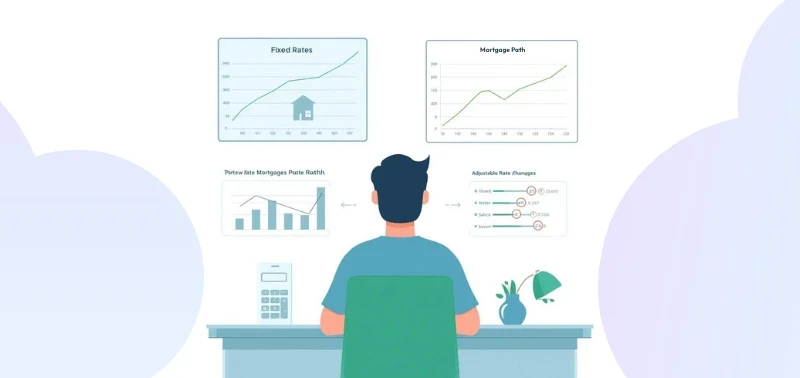
When you refinance your mortgage, one of the biggest decisions you’ll make is whether to choose a fixed-rate mortgage (FRM) or an adjustable-rate mortgage (ARM). Both options can save you money — but only if you understand how the interest rate structure aligns with your financial goals, plans, and risk tolerance.
A fixed-rate mortgage gives you long-term stability. An adjustable-rate mortgage may provide a lower initial rate and lower payments — but with future uncertainty.
So which one should you choose?
The surprising part: the best option often depends less on the loan type — and more on how your lender priced the offer.
This guide breaks down the differences between fixed and adjustable rates, provides real savings examples, explains when each option makes sense, and shows how Fincast helps you compare offers.
Key Takeaways
Fixed-rate mortgages provide predictable payments and long-term stability
Adjustable-rate mortgages (ARMs) offer lower initial rates but can increase after the fixed period
ARMs can be smart for short-term stays — but risky if rates rise
Fixed mortgages are best for long-term homeowners or those prioritizing stability
The best choice depends on your timeline, budget, and risk tolerance — not just the rate
Comparing lenders is essential because ARM and fixed-rate pricing vary significantly
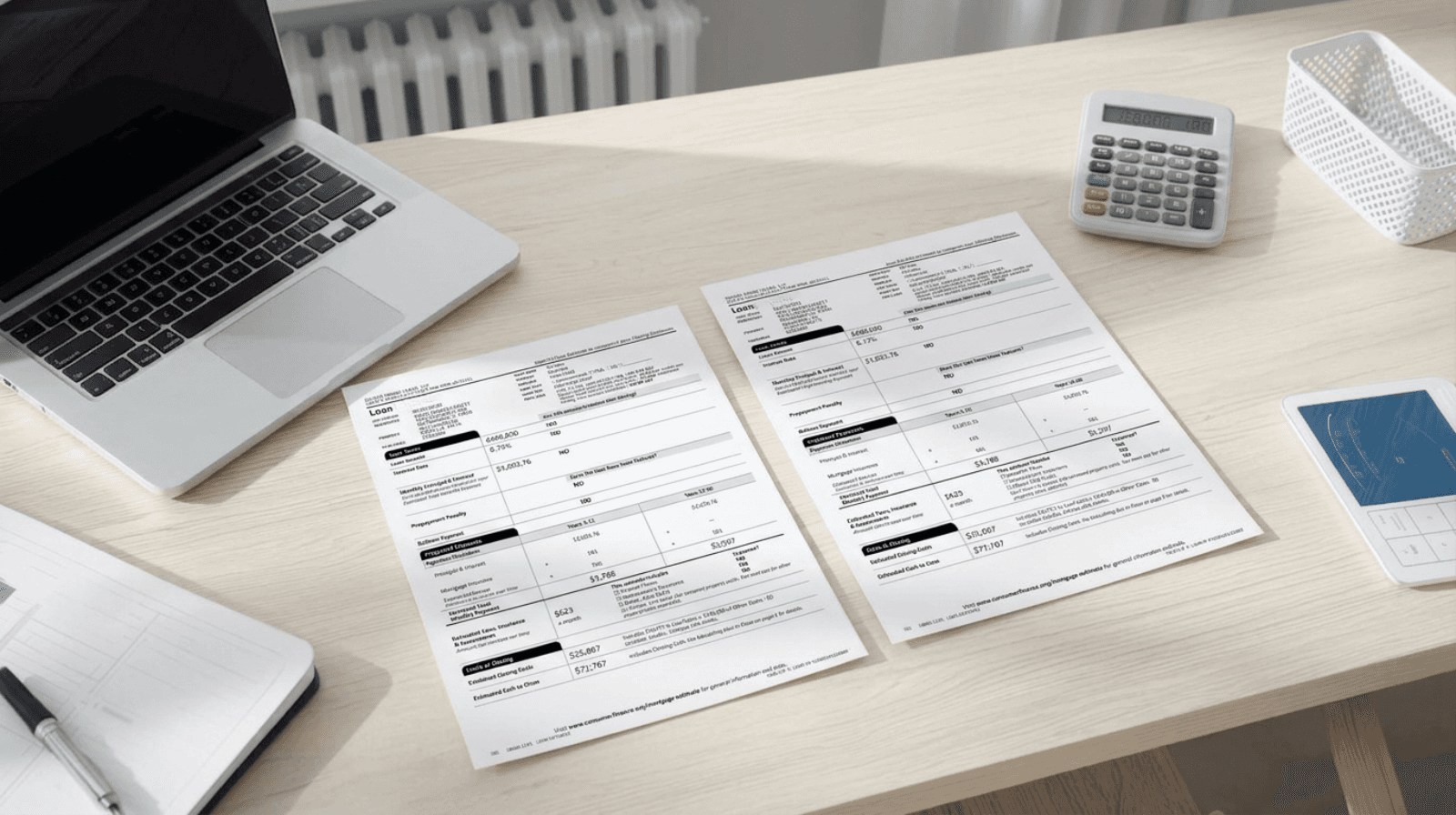
💡 Pro Tip: Once you receive your Loan Estimate, upload it to Fincast. The platform analyzes your current offer and allows vetted lenders to review your Loan Estimate and submit alternative offers with no extra credit pull and no spam.
Why This Decision Is Harder Than It Looks
Many homeowners compare only the interest rate when choosing between a fixed-rate and an adjustable-rate mortgage.
But two lenders offering the same rate can differ by thousands of dollars in points, fees, or margin structure.
And with ARMs, the adjustment caps and margins vary widely among lenders, so the long-term cost can be significantly different even when the initial rate looks similar.
This is why reviewing the full Loan Estimate matters.
What Is a Fixed-Rate Mortgage?
A fixed-rate mortgage has an interest rate that stays the same for the entire life of the loan. Your monthly principal and interest payment never change.
Advantages of a Fixed Rate
Predictable monthly payments
Protection against rising rates
Easier long-term budgeting
Simpler break-even analysis
Disadvantages
Higher initial rate compared to ARMs
Higher payment in the early years
It might not be optimal if you plan to move soon
Fixed-rate mortgages are ideal when you want stability or plan to stay in your home long-term.
What Is an Adjustable-Rate Mortgage (ARM)?
An ARM offers a lower fixed rate for an initial period — such as 5, 7, or 10 years — followed by periodic adjustments based on market rates (often yearly).
Common ARM types:
5/1 ARM → Fixed for 5 years, adjusts every year after
7/1 ARM → Fixed for 7 years
10/1 ARM → Fixed for 10 years
Advantages of an ARM
Potentially lower initial rate
Lower payment during the fixed period
Can be ideal for short-term plans
Potential savings if you refinance or sell before adjustments
Disadvantages
Rate — and payment — can increase after the fixed period
More complex pricing
Requires risk tolerance
Harder break-even predictions
ARMs reward short-term planning but carry uncertainty if you keep the loan long-term.
Fixed vs. ARM: Real Savings Examples
Let’s look at how these options compare based on illustrative market pricing examples. Actual rates vary by lender, credit profile, loan type, and market conditions.
Example Scenario: $400,000 refinance
Loan Type | Initial Interest Rate | Monthly Payment (P&I) | Difference |
30-Year Fixed | 6.25% | ~$2,462 | — |
7/1 ARM | 5.50% | ~$2,271 | Saves ~$191/mo |
5/1 ARM | 5.25% | ~$2,209 | Saves ~$253/mo |
Short-term: In many scenarios, ARMs produce lower initial payments.
Long-term: A fixed rate is the safer choice — especially if rates rise.
When a Fixed-Rate Refinance Makes the Most Sense
✔️ You plan to stay 7+ years
The longer you stay, the more valuable stability becomes.
✔️ You prefer predictable payments
No surprise increases.
✔️ Rates are reasonably low
If fixed rates drop even slightly, refinancing into a fixed mortgage can generate big long-term savings.
✔️ You don’t want to monitor rate markets
Fixed rates require zero long-term management.
✔️ You expect rates to rise in the future
A fixed rate locks in protection.
When an ARM Refinance Makes the Most Sense
✔️ You plan to sell or move within 3–7 years
You get the lower rate without ever reaching the adjustment period.
✔️ You plan to refinance again soon
Borrowers waiting for rates to drop often choose ARMs in the meantime.
✔️ You want the lowest possible payment today
The savings can be meaningful for cash flow, investing, or paying off debt.
✔️ You can tolerate future rate uncertainty
Especially if you’re financially flexible.
✔️ You expect rates to fall later
In rare cases, adjustments could benefit you — but this is speculative.
ARM Risks You Should Understand
If you refinance into an ARM, pay attention to:
1. Adjustment Caps
These limit how much your rate can increase:
Initial adjustment cap (first year after fixed period)
Periodic cap (annual increases)
Lifetime cap
Example: A 5/1 ARM might have a 5/2/5 or 2/2/5 cap structure:
Up to 5% or 2% increase at the first adjustment
Up to 2% annually after that
Up to 5% total over the life of the loan
2. Index + Margin Structure
After the fixed period:
New rate = Index + Margin
Each lender sets margins differently.
3. Market Volatility
If rates spike in the future, your ARM rate could increase significantly depending on market conditions.
4. Payment Shock
Payment increases can destabilize your budget if you’re unprepared.
Fixed vs. ARM: How This Choice Impacts Your Break-Even Point
Your loan type can dramatically change:
Monthly savings
Refinance cost justification
Long-term interest paid
Timeline to break even
Example: $8,000 refinancing cost
Fixed-rate refinance savings: $160/month
ARM refinance savings: $260/month
ARMs often break even faster — but only if you leave before adjustments.
The Biggest Mistakes Homeowners Make When Choosing Fixed vs. ARM
❌ Choosing an ARM without understanding adjustment caps
❌ Picking a fixed rate when you plan to move in 2–4 years
❌ Comparing only the rate without looking at the points
❌ Assuming all lenders price ARMs the same way
❌ Not calculating break-even based on real numbers
❌ Not comparing multiple Loan Estimates
This decision is too important to make based on a single quote.
How Fincast Helps You Choose the Best Option
Most homeowners never see how competitive their refinance offer really is.
Fincast helps homeowners compare their Loan Estimate against alternative lender pricing.
Here’s how it works:
1. Upload your Loan Estimate
Secure upload in about 60 seconds.
2. Fincast analyzes both loan types
You instantly see:
Fixed vs. ARM pricing
Points
Credits
Adjustment structures
True cost comparisons
3. Lenders may submit competing offers
Qualified lenders can review your scenario and provide alternative pricing.
4. You see whether your deal is strong or overpriced
No spam
No sales calls
No additional credit pull
Just a clear view of whether your refinance offer is competitive.
FAQs: Fixed-Rate vs. ARM Refinancing
Is a fixed-rate mortgage better for refinancing?
If you plan to stay long-term or value stability, yes. But ARMs may offer lower initial rates.
Are ARM rates always lower than fixed rates?
Usually, during the fixed period, but there’s no guarantee. After that, the rate can adjust upward.
Is refinancing into an ARM risky?
Only if you keep the loan past the fixed period or if rates rise significantly.
Can I refinance again before an ARM adjusts?
Yes, many ARM borrowers refinance again before the adjustment.
Does choosing a fixed-rate vs. an ARM affect closing costs?
ARMs sometimes involve slightly lower lender fees, but it depends on the lender’s pricing model.
Bottom Line
Before locking your refinance, it’s worth confirming whether your lender’s offer is competitive.
Many borrowers discover that another lender can offer:
• the same rate with lower fees
• a better ARM margin structure
• or lower points for the same payment
Uploading your Loan Estimate to Fincast lets you quickly verify it.
Action Checklist
☑️ Determine how long you plan to stay in the home
☑️ Compare fixed vs. ARM monthly payments
☑️ Review ARM adjustment caps and margins
☑️ Calculate your break-even point
☑️ Request a Loan Estimate from a lender
☑️ Upload your Loan Estimate to Fincast
☑️ Compare lender ARM and fixed offers anonymously
☑️ Choose the refinance option that maximizes savings and fits your timeline
👉 Ready to see whether a fixed-rate or ARM refinance saves you more? Upload your Loan Estimate to Fincast and let vetted lenders compete to give you the best rate — fixed or adjustable — no spam, no sales calls, and no extra credit pulls.
This article is for educational purposes only and is not a commitment to lend. Mortgage terms depend on lender approval and borrower qualifications.
Disclaimer: Nothing in this content should be considered financial advice. The examples and data shared are for general information only and may not reflect your personal situation. We do not guarantee the accuracy or completeness of the information provided. Always do your own research and speak with a qualified financial advisor before making any financial decisions.
Ready to Save On Your New Mortgage?