
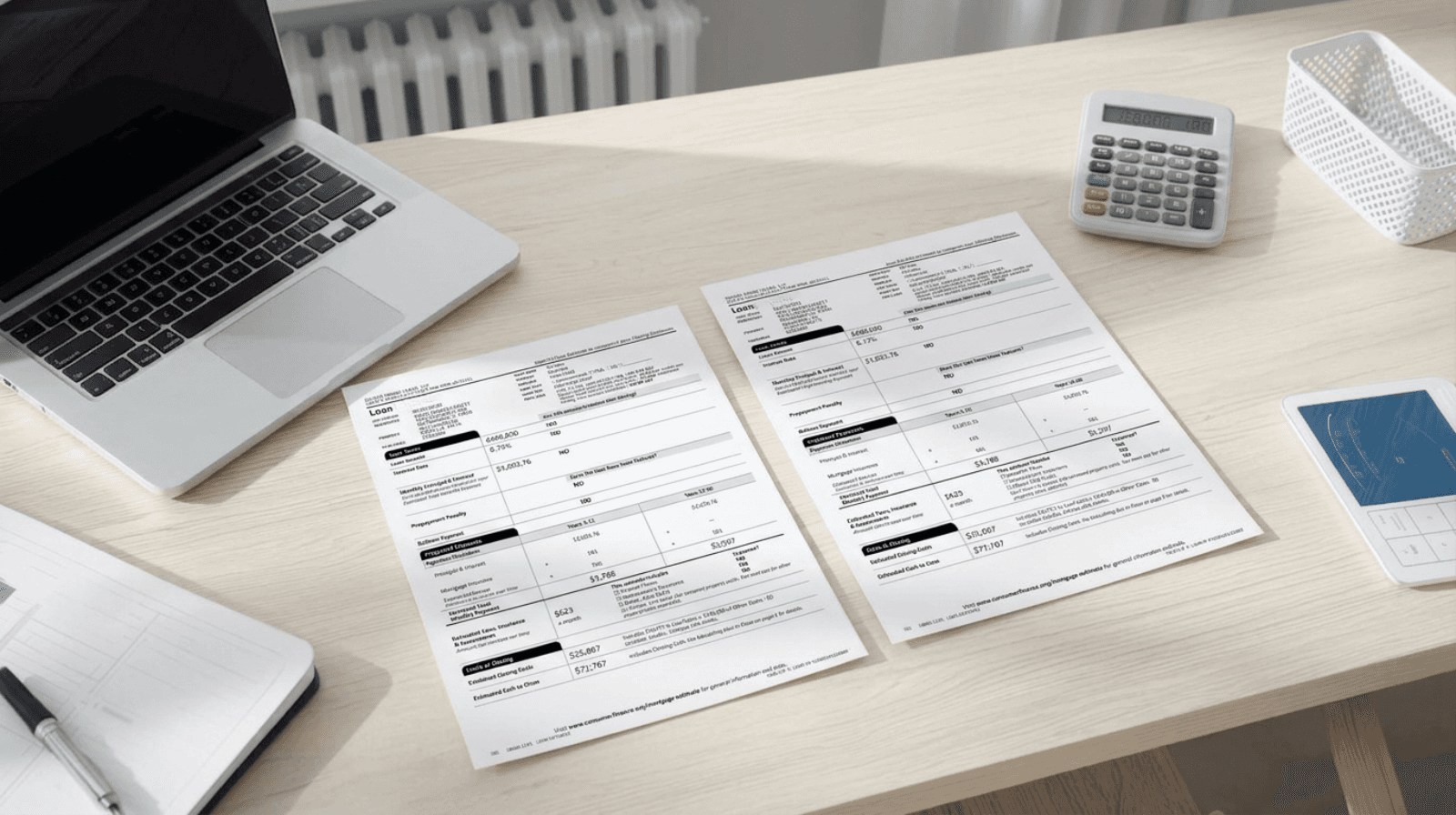
If you're wondering how to compare loan estimates, the key is knowing which numbers matter and which ones lenders can manipulate. Most homebuyers assume that getting the best mortgage rate means applying with five different lenders, collecting a stack of paperwork, and spending hours building a comparison spreadsheet. It doesn't have to work that way.
You only need one Loan Estimate to start. Once you have it, the right process — and the right tools — can surface competing offers without the legwork.
The key is knowing what the numbers actually mean when those competing bids come in. A Loan Estimate shows your projected interest rate, monthly payment, and closing costs. But the differences that matter are buried in the details: lender fees, APR, cash to close, and which costs are actually negotiable.
This guide walks you through exactly how to compare loan estimates step by step, so you can confidently choose the best mortgage offer.
Key Takeaways
Loan Estimate: A federally required, three-page form sent within three business days of your mortgage application — standardized across all lenders so competing offers can be compared on equal footing.
What to Compare: Not just the interest rate. The numbers that matter most are APR, Section A origination charges, cash to close, and projected monthly payment.
Biggest Difference: Interest rate = what the lender advertises. APR = what you actually pay.
What to Focus on When Comparing Loan Estimates
When competing bids arrive, here's where to focus your attention. Not every line matters equally — these are the ones that do:
What to Compare | Where to Find It | Why It Matters |
Interest Rate | Page 1 — Loan Terms | Starting point, but not the full cost picture |
APR | Page 3 — Comparisons | Includes fees — the most accurate true-cost metric |
Section A: Origination Charges | Page 2 — Closing Costs | The lender's own fees — directly negotiable |
Section B: Required Services | Page 2 — Closing Costs | Third-party costs lenders select — compare across bids |
Section C: Shoppable Services | Page 2 — Closing Costs | Title, settlement fees — you can get your own quotes here |
Estimated Cash to Close | Page 2 — bottom | All-in upfront cost including down payment and closing costs |
Projected Monthly Payment | Page 1 — bottom | Principal, interest, mortgage insurance, and escrow combined |
How to Compare Loan Estimates Step by Step
Learning how to compare Loan Estimates is simpler than most homebuyers expect. However, before comparing offers, make sure you're looking at a real Loan Estimate and not a fee sheet. Our guide on Loan Estimate vs Fee Sheet explains the difference.
Step 1: Make Sure You’re Comparing Actual Loan Estimates
Lenders must provide a Loan Estimate within three business days of receiving your mortgage application. Make sure the document you receive is an actual Loan Estimate, not a Loan Summary. Our guide on Loan Estimate vs Loan Summary explains the difference.
Step 2: Check Loan Type, Term, and Rate Type
Before comparing rates, fees, or monthly payments, confirm that every Loan Estimate is based on the same type of mortgage. If the structure of the loan is different, the numbers aren’t truly comparable.
Start by checking the Loan Terms section on Page 1 of each Loan Estimate. Focus on three key details:
Loan Type
This tells you the mortgage program. The most common are conventional, FHA, VA, and USDA loans. Each program has different mortgage insurance rules, credit requirements, and closing costs. Comparing an FHA loan to a conventional loan can produce very different payments and fees.
Loan Term
The loan term is how long you’ll repay the mortgage — typically 30 years or 15 years. A 15-year loan usually has a lower interest rate but a much higher monthly payment. If one lender quotes a 30-year loan and another quotes a 15-year loan, the numbers will look dramatically different even though the comparison isn’t apples-to-apples.
Rate Type
Check whether the loan is a fixed-rate or adjustable-rate mortgage (ARM). A fixed-rate mortgage keeps the same interest rate for the entire loan term. An adjustable-rate mortgage starts with a lower introductory rate but can change after the initial period.
Some lenders advertise lower payments by switching the loan to an ARM or shortening the introductory rate period. That doesn’t necessarily mean the deal is better — it simply means the loan works differently.
👉 Rule of thumb: Before comparing costs, make sure the loan type, term, and rate type match across all Loan Estimates. Once those are identical, you can start evaluating which lender actually offers the better deal.
Step 3: Compare the Interest Rate, APR, and Lender Credits
When multiple Loan Estimates arrive, resist the urge to rank them by interest rate alone. The rate is important, but it doesn’t tell the full story about what the loan will actually cost.
Instead, turn to Page 3 of each Loan Estimate and look at the APR (Annual Percentage Rate). APR combines the interest rate with most lender fees, giving you a more accurate view of the true annual cost of the loan.
Two lenders can offer the same interest rate but very different APRs if one charges significantly higher fees. In that case, the loan with the higher APR is usually the more expensive option over time.
You should also look for lender credits, which appear in the closing cost section. Lender credits reduce the amount you pay upfront at closing, but they typically come with a higher interest rate. In other words, the lender is covering some of your closing costs in exchange for a slightly more expensive loan over time.
👉 Key comparison rule:
Look at the interest rate, APR, and lender credits together. A slightly higher rate with lower fees — or fewer lender credits — can sometimes be the better long-term deal.
Step 4: Review Origination Charges and Third-Party Fees
Page 2 of every Loan Estimate lists closing costs by section. Section A is the lender's own fees — origination, underwriting, and processing charges. These are directly negotiable. If one bid shows $2,500 in origination charges and another shows $400 for the same loan, that difference is real money — and a legitimate reason to push back or ask for a match.
Step 5: Check Section C — and Know You Can Shop It
Section C covers services you're allowed to shop for yourself — title insurance, settlement agents, and similar third-party costs. The CFPB explicitly gives you this right. Even with competing bids in hand, calling two or three vendors on Section C services can shave hundreds of dollars off your closing costs.
Step 6: Compare Cash to Close
Cash to close is your all-in upfront number — down payment plus closing costs, minus any credits. When comparing bids, watch for two things:
Lender credits lower your cash-to-close, but come with a higher rate. This is a real trade-off, not a discount.
Discount points lower your rate but increase the upfront cost. Whether that math works depends on how long you plan to keep the loan.
The CFPB's guide to comparing loan offers breaks down how credits and points affect your total cost over time — worth reviewing before making a final call.
Step 7: Watch for Product Changes Disguised as Savings
It’s important to understand the Loan Estimate red flags to monitor. For example, some lenders make their offer look cheaper by subtly changing the loan structure. A slightly lower payment might come from switching to an adjustable-rate mortgage, removing escrow, or adding lender credits that increase your interest rate. Always confirm that the loan type, term, and structure are identical before comparing costs.
Step 8: Use a Side-by-Side Comparison Process
The easiest way to compare Loan Estimates is side by side. Place the Loan Estimates next to each other and compare the same lines across documents: rate, APR, Section A fees, cash to close, and monthly payment.
Tools like Fincast automate this comparison so you can evaluate competing offers without building your own spreadsheet.
Why This Process Matters
Even small differences between bids add up fast. A 0.25% difference in rate on a $400,000 mortgage represents over $20,000 in additional interest over 30 years. A $1,500 gap in origination charges is $1,500 straight out of your pocket at closing.
Most homebuyers either don't shop at all, or they shop manually — filling out multiple applications, fielding calls from multiple loan officers, and trying to compare PDFs on their own. Neither approach is ideal.
Get Competing Offers Without the Legwork
Most homebuyers don't realize they can get competing bids without applying with multiple lenders. That's exactly what Fincast makes possible.
Upload your Loan Estimate, and vetted lenders submit competing offers based on your actual terms. You compare those bids against each other — and against your original estimate — in one place.
✅ No multiple applications
✅ No extra credit pulls
✅ No spam
You'll see how your deal stacks up — before you close.
FAQs
1. Do I need to apply with multiple lenders to get competing offers?
Shopping multiple lenders is always recommended — but it doesn't have to mean multiple applications. With Fincast, you upload one Loan Estimate, and vetted lenders submit competing bids directly, without extra paperwork or credit pulls.
2. Can I negotiate after seeing the competing bids?
Absolutely. If a competing bid offers better terms than your original lender's, share it and ask them to match it. Many will. Just make sure any agreed-upon changes are reflected in a revised written Loan Estimate before you proceed.
3. Do loan estimates expire?
A Loan Estimate is typically valid for 10 business days from the issue date. After that, the lender can revise the terms. Request an updated estimate or lock your rate before it expires.
4. Why does APR matter more than the interest rate?
APR includes lender fees alongside the rate, giving you the true annual cost of the loan. Two bids with identical interest rates can have very different APRs if one comes with significantly higher fees — and APR is how you catch that.
5. What's the difference between a Loan Estimate and a Closing Disclosure?
The Loan Estimate comes early — within three days of your application. The Closing Disclosure arrives near closing and locks in your final numbers.
Bottom Line
You only need one Loan Estimate to start. Upload it, let vetted lenders compete, and use this guide to understand what the bids actually mean — so you can make a confident, informed decision before you close.
Pro Tips (Save These!)
✅ You only need one Loan Estimate to get started — Fincast does the rest.
✅ Compare APR across bids, not just interest rate.
✅ Section A origination charges are negotiable — push back.
✅ Get your own quotes for Section C services to cut closing costs.
✅ Always get revised estimates in writing before locking your rate.
Action Checklist
☑️ Apply with a lender and get your Loan Estimate
☑️ Upload your Loan Estimate to Fincast
☑️ Review competing bids using APR, not just interest rate
☑️ Compare Section A origination charges across bids
☑️ Get your own quotes for Section C shoppable services
☑️ Negotiate using your strongest competing bid
☑️ Lock your rate only after receiving a revised written estimate
👉 Ready to see what lenders will offer on your deal? Upload your Loan Estimate to Fincast and see if vetted lenders have more competitive offers.
Disclaimer: Nothing in this content should be considered financial advice. The examples and data shared are for general information only and may not reflect your personal situation. We do not guarantee the accuracy or completeness of the information provided. Always do your own research and speak with a qualified financial advisor before making any financial decisions.
Ready to Save On Your New Mortgage?